
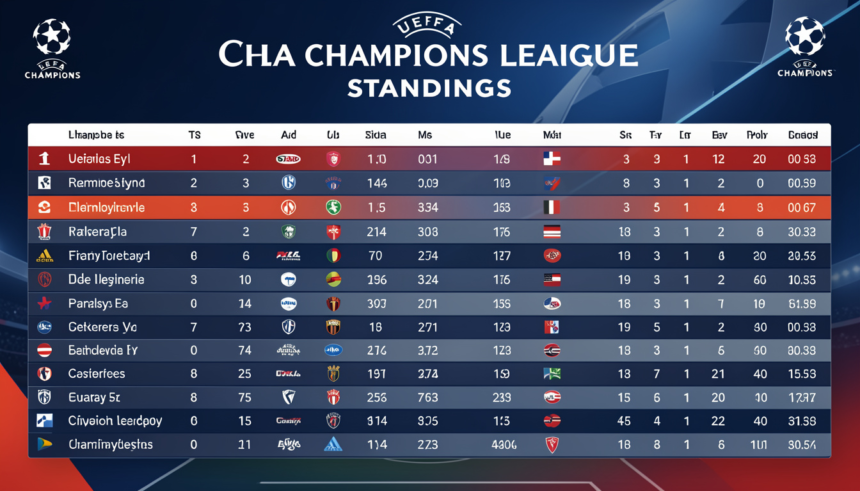
The term tabla de la Champions is a Spanish expression referring to the standings table of the UEFA Champions League, the most prestigious football tournament in Europe. For fans worldwide, the Champions League table is more than just numbers—it represents strategy, performance, and the thrilling uncertainty of football at the highest level.
From group stage battles to knockout rounds, the table determines which teams advance and which face elimination. This article explores the tabla de la Champions, its structure, significance, and how fans can follow it in real time.
What Is the Tabla de la Champions?
The tabla de la Champions is the official standings that track team performance during the Champions League season. In the group stage, teams are divided into groups, usually four per group, and play six matches: home and away against each opponent.
The table typically includes the following columns:
- Matches Played (P)
- Wins (W)
- Draws (D)
- Losses (L)
- Goals For (GF)
- Goals Against (GA)
- Goal Difference (GD)
- Points (PTS)
Each team’s performance in these categories determines their position in the group. The top two teams advance to the knockout stage, while the third-placed team often drops to the UEFA Europa League.
Sample Tabla de la Champions
Here’s an example of how a typical group table looks:
| Position | Team | P | W | D | L | GF | GA | GD | PTS |
| 1 | Real Madrid CF | 6 | 4 | 1 | 1 | 12 | 5 | +7 | 13 |
| 2 | Liverpool FC | 6 | 3 | 2 | 1 | 10 | 6 | +4 | 11 |
| 3 | AC Milan | 6 | 2 | 1 | 3 | 8 | 9 | -1 | 7 |
| 4 | Red Bull Salzburg | 6 | 0 | 2 | 4 | 4 | 14 | -10 | 2 |
This table allows fans to quickly understand which teams are in control, which are struggling, and who has a chance to advance.
How Teams Earn Points
Points in the Champions League are awarded as follows:
- Win: 3 points
- Draw: 1 point
- Loss: 0 points
When teams are tied on points, UEFA applies tie-breaking criteria:
- Head-to-head points between tied teams
- Head-to-head goal difference
- Overall goal difference
- Goals scored
This ensures that both overall performance and direct competition between teams determine rankings fairly.
Structure of the UEFA Champions League
The UEFA organizes the Champions League with multiple phases:
- Qualification Rounds: Some teams must play qualifiers to reach the group stage.
- Group Stage: 32 teams are divided into 8 groups of 4. Each team plays 6 matches.
- Knockout Stage: The top two teams from each group move to the Round of 16, followed by quarterfinals, semifinals, and the final.
The final determines the champion of Europe, with enormous financial, sporting, and historical significance.
Why the Tabla de la Champions Matters
The table is critical for several reasons:
- Determines Qualification: Only the top two teams in each group advance to the knockout stage.
- Reflects Club Performance: Clubs like Real Madrid CF, Manchester City FC, FC Bayern Munich, and FC Barcelona frequently appear at the top due to consistent strong performances.
- Impacts Finances: Advancing increases prize money and sponsorship opportunities.
- Global Reputation: Strong performance enhances a club’s prestige worldwide.
Famous Comebacks in the Tabla de la Champions
The Champions League has seen incredible comebacks that changed group standings. Teams like Liverpool FC and AC Milan have overturned difficult positions to advance to later stages.
Even clubs like Paris Saint-Germain FC have experienced dramatic shifts, proving that the table is dynamic and one match can change the trajectory of an entire campaign.
Following the Tabla de la Champions
Fans today can follow standings easily via:
- Official UEFA websites
- Sports news outlets
- Mobile apps
- Live score services
Social media discussions intensify around major matchdays, especially the last round of group stage games, when multiple teams may be fighting for a single qualification spot.
Psychological Impact of the Table
The position of a team in the table also affects tactics and mindset:
- Top teams: Confident, can rotate players, and manage risk.
- Mid-table teams: Strategic, may play conservatively or aggressively depending on needs.
- Bottom teams: High pressure, must win to survive.
The standings are thus not just statistical—they influence strategy, morale, and decision-making throughout the season.
Financial and Sporting Consequences
Finishing first or second has tangible benefits:
- Better seeding in knockout draws
- Home advantage in second-leg matches
- Higher prize money and commercial exposure
Conversely, elimination can lead to financial loss and affect club morale and future recruitment.
Conclusion
The tabla de la Champions is more than a ranking system—it’s a narrative of triumph, tension, and competition across Europe. Each point reflects preparation, skill, and sometimes heartbreak.
From dominant clubs like Real Madrid to emerging challengers, the table shows who is in contention and who must fight for survival. For fans, the standings are the heartbeat of the Champions League, giving context to every goal, every match, and every unforgettable moment on the European stage.
FAQs
What does “tabla de la Champions” mean?
It is the official standings table of the UEFA Champions League, showing team rankings, points, and performance metrics.
How many teams qualify from each group?
The top two teams in each group advance to the Round of 16. The third-placed team often enters the UEFA Europa League.
What happens if two teams have the same points?
Tie-breakers include head-to-head results, goal difference, and goals scored, in that order.
How are points awarded?
Teams earn 3 points for a win, 1 point for a draw, and 0 points for a loss.
Why is the Champions League table important?
It determines qualification, affects finances, influences strategy, and reflects a club’s competitive status in European football.